ON THIS PAGE:
Start PROCYSBI immediately after diagnosis of nephropathic cystinosis1
PROCYSBI® (cysteamine bitartrate) delayed-release capsules and delayed-release oral granules should be initiated immediately following diagnosis of nephropathic cystinosis in patients aged ≥1 year.1
Early cystine-depleting therapy (CDT) treatment can delay or limit damage from cystine accumulation. Treatment cannot reverse damage that has already occurred.2-4

Request a Rep
If you have questions or would like to learn more about appropriate dosing and administration, you may connect with a representative.

Review Prescribing Information
To learn more about PROCYSBI, please see the Prescribing Information.
Determine dose by patient experience with cysteamine bitartrate1
Patients switching from immediate-release (IR) cysteamine bitartrate should start PROCYSBI by taking a total daily dose equal to their previous total daily dose.1
For cysteamine-naïve patients, PROCYSBI should be initiated with a dosage equal to one-sixth to one-fourth of the maintenance dose. The maintenance dosage after initial dose escalation is 1.3 g/m2 of body surface area (BSA) per day divided into 2 doses given every 12 hours.1
An Amgen Representative can provide more information on calculating dosage for weight above 51 kg (112 lb).
Starting and maintenance dosage of PROCYSBI by body weight for cysteamine-naïve patients1,*†
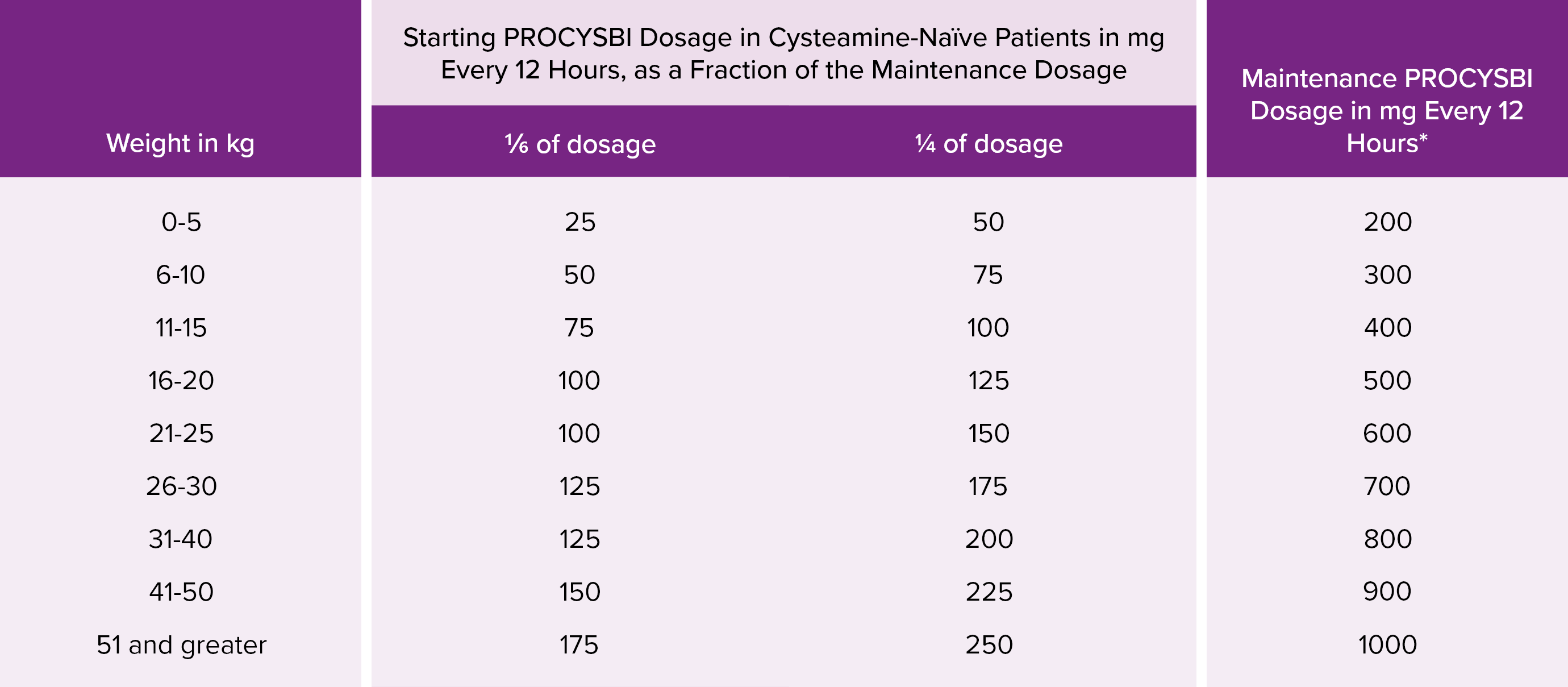
*Higher dosages may be required to achieve target therapeutic WBC cystine concentration. The maximum dosage of PROCYSBI is 1.95 grams/m2 of body surface area per day.
†Dosage rounded using available strengths of capsules or packets of oral granules.
If you have questions or would like to learn more about appropriate dosing and administration, you may connect with a representative.
Dosing Flashcard
For dosing calculations by patient weight, download the dosing flashcard.
Starting low and slowly increasing the dose may reduce the risk of some adverse events1
- Patients aged 1 year to <6 years: Increase the dosage in 10% increments to the maintenance dosage while monitoring white blood cell cystine concentration.
- Patients aged ≥6 years: Gradually increase the dosage over 4 to 6 weeks until the maintenance dosage is achieved.
Administration Options
PROCYSBI offers flexibility in administration, with 3 different ways your patients can take it.1
1 - Swallowed whole
PROCYSBI capsules can be swallowed whole with fruit juice (except grapefruit juice) or water. Do not crush or chew the capsules.1
2 - Opened and mixed with select foods or liquids
For patients who cannot tolerate PROCYSBI on an empty stomach or have difficulty swallowing, capsules or packets should be opened and the microbeads mixed with select foods or liquids. The microbeads may be mixed in about ½ cup (4 oz.) of applesauce, berry jelly, or fruit juice (except grapefruit juice). The mixture should be consumed within 30 minutes of mixing and should not be saved for later use.1
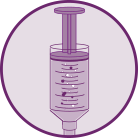
3 - Through a G-tube
For individuals with a G-tube that is size 14 French or larger, PROCYSBI capsules or packets should be opened and the microbeads mixed with about ½ cup (4 oz.) of strained applesauce with no chunks. The mixture should be administered within 30 minutes of mixing and should be not saved for later use.1

Stomach acidity affects the release and absorption of PROCYSBI
To maintain the right stomach acid levels for continuous cystine control, patients should1:
Take PROCYSBI at least 1 hour before or after they take medicines that contain bicarbonate or carbonate.

Not eat for at least 2 hours before and 30 minutes after taking PROCYSBI.

Take PROCYSBI with no more than ½ cup (4 oz) of food up to 1 hour before or after they take it, if they cannot tolerate PROCYSBI on an empty stomach.

Start your patients on PROCYSBI

Help patients understand correct usage
Stay informed about PROCYSBI and cystinosis
1. PROCYSBI (cysteamine bitartrate) delayed-release capsules and delayed-release oral granules [prescribing information]. Amgen. 2. Nesterova G, Gahl WA. Cystinosis: the evolution of a treatable disease. Pediatr Nephrol. 2013;28(1):51-59. 3. Gahl WA, Balog JZ, Kleta R. Nephropathic cystinosis in adults: natural history and effects of oral cysteamine therapy. Ann Intern Med. 2007;147(4):242-250. 4. Elmonem MA, Veys KR, Soliman NA, van den Heuvel LP, Levtchenko E. Cystinosis: a review. Orphanet J Rare Dis. 2016;11:47. 5. Mosteller RD. Simplified calculation of body-surface area. N Engl J Med. 1987;317(17):1098.